

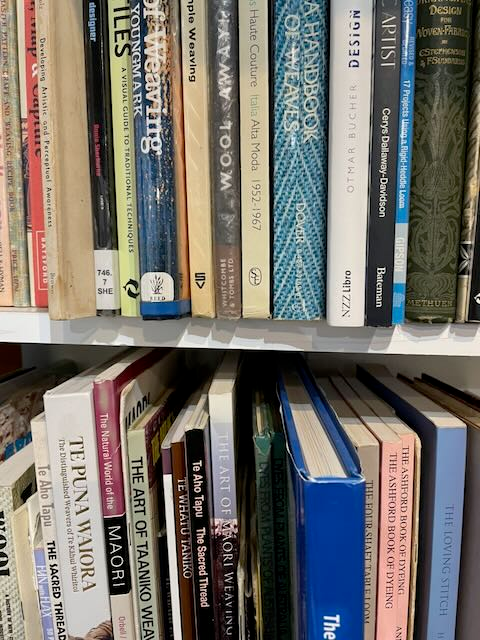
The textile library in the studio in Māwhera Greymouth has books on lots of different subjects; design, art, makers, techniques, culture, colour, history and so on. That makes cataloguing the publications a difficult proposition.
Libraries are, of course, important repositories of knowledge but they are also places where connections are made, where ideas happen and where inspiration abounds. Many libraries use the Dewey Decimal Classification, devised by an American librarian, Melvil Dewey, in 1873 while working at Amherst College in Massachusetts, but this numbering and lettering system has a serious drawback. The library in Greymouth contains books on Zimbabwean basketry and art, Pacific Tapa, Māori weaving and plaiting, Shetland crafts, and much more besides. The Dewey system relegates these to a handful of numbers and makes them subservient to the Western way of looking at the world. As an example, Fun with Flax: 50 projects for beginners by Mick Pendergrast shares the same catalogue number with Handwoven Laces by Donna Muller. The flax book was devised to help beginners learn the basic skills of Māori plaiting crafts while the latter is a technical book that explores and explains the techniques of making cloths that have an open texture when they are washed. As there are a number of books about various Māori crafts and arts the problem becomes apparent quite quickly. To find the flax book one would need to search online for either a keyword (e.g, Māori) or know who the author is and what the book is about.
While this may not seem to be an issue, when a library is filled with books about, say, Māori craft and art, but also has a significant quantity of books about cultures across the globe as well as technical books, it would seem that there should be a different way of cataloguing the publications. The subtleties of defining publications that take into account local knowledge are lost in the Dewey Decimal System.
We are not the only ones grappling with this issue. The National Library of New Zealand uses Māori words to describe concepts and worldviews as part of their cataloguing system. The term resource management (Whakahaere rawa) has moved from Taiao (Environment) to Economy (Ohanga) recently because the implication of a transactional approach in the term does not take into account the care for the environment and earth that is an important part of te ao Māori (Māori worldview). Moving Whakahaere rawa to Ohanga is more accurate and keeps the respect for Taiao intact.
Now the question is how do we catalogue the studio collection? Do we use something akin to the The Brian Deer Classification System from Canada or the AIATSIS Pathways Thesaurus from Australia, or do we create a whole new system that takes into account the publications that exist in the library and the people who might come into peruse them?
If you have any ideas about how best to catalogue the books please get in touch. It is always interesting and useful to hear from others how they like to make use of resources such as the library, and a diversity of opinion is welcome.