

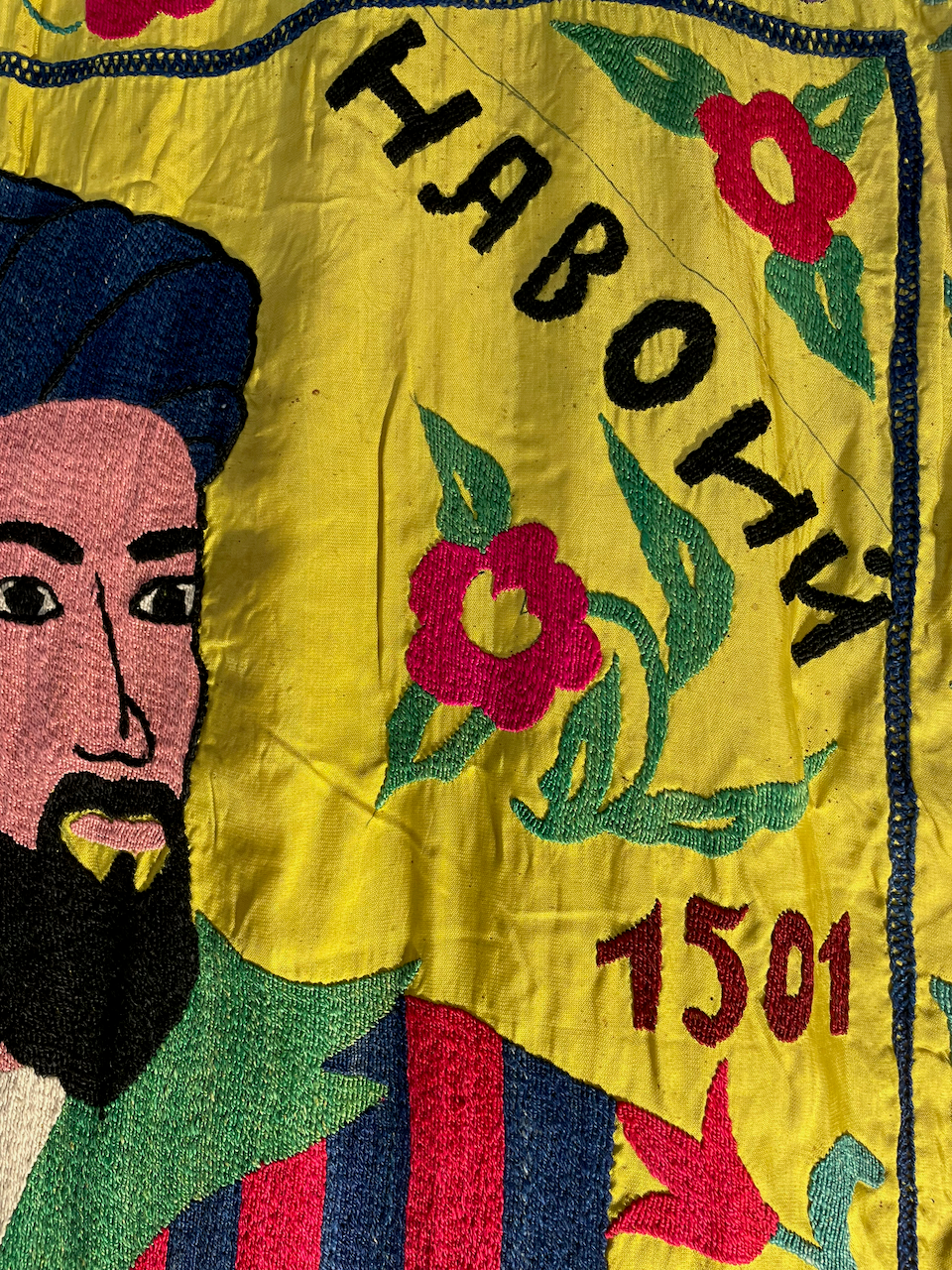
The studio collection of textiles, costume, fashion and art includes some special pieces. This wall hanging, a depiction of the artist/ linguist/ statesman/ poet and fierce defender and exponent of the Chagatai Turkic language, Ali-Shir Nava’i, is one of those.
The work is made of silk and cotton with embroidery decoration and edges of crochet. Small tassels of wool hang off the bottom and the edges are quilted with free-machine embroidery. There is other crochet decoration on the piece, and an applique border runs around the inner edge as well as a corded braid. The hanging is almost 99cm wide and 180cm long.
The motifs on the hanging include a portrait of its subject, and a surrounding of embroidered flowers, stems and leaves in bright colours: red, purple, maroon and dark blue. Two peacocks sit, eyes averted, below the portrait. Peacocks are symbols of Paradise and the soul in Central Asian folklore. Their tail feathers with its eyes act as a talisman, warding off bad luck or evil intentions and their mirrored placement represents balance and harmony.
There are three dates on the panel. One is embroidered at the bottom, one numeral in each of four flowers: 1980. Another says “525 years” in embroidery while the third indicates the birth and death dates of this important figure. In 1980 Ali-Shir Nava’i was celebrated on the 540th year of his birth. 525 years after 1441 gives us the date 1966, an important date for the poet because that was when Robert Devereux translated and published and English version of “The Trial of the Two Languages” by Nava’i.
The reputation of the statesman was downplayed for many years while the Soviet Union was in existence. Now that the Cold War has ended and the former Soviet states are independent, his achievements are proudly celebrated.
Links: